The user wants me to write an SEO-friendly affiliate article for the "Loveberry Bold Font" product from Creative Fabrica. Let me carefully follow all the rules and requirements.
Let me plan this out:
1. 600-800 words
2. No title or meta description
3. Mention "Loveberry Bold Font" within first 100 words
4. Use internal links naturally from the provided URLs
5. One external link with font name as anchor
6. Link font names once each with the Creative Fabrica search URL
7. Use headings based on real reader questions
8. Avoid AI-style phrases
9. Write in natural human tone
10. End with a practical checklist, tip, or next step
11. Clean HTML fragment only
Let me identify the internal links:
- /enjoy-being-font-display-fonts
- /loveberry-bold-font-display-fonts
- /haydn-font-display-fonts
- /summer-komika-font-display-fonts
- /the-western-font-display-fonts
External link: one allowed, using font name as anchor text, with target="_blank" rel="sponsored nofollow"
Font name links (Creative Fabrica search):
- Loveberry Bold: https://www.creativefabrica.com/search/ref/1593254/?query=Loveberry+Bold
- Enjoy Being: https://www.creativefabrica.com/search/ref/1593254/?query=Enjoy+Being
- Haydn: https://www.creativefabrica.com/search/ref/1593254/?query=Haydn
- Summer Komika: https://www.creativefabrica/search/ref/1593254/?query=Summer+Komika
- The Western: https://www.creativefabrica.com/search/ref/1593254/?query=The+Western
Wait, let me re-read: "Link fonts name one time each font https://www.creativefabrica.com/search/ref/1593254/?query=font name"
So each font mentioned should be linked once to its search page.
And the external link - "Can add 1 external link for reference" - this would be something else, maybe a typography resource or something.
Actually, looking at this again, the internal links should use natural anchor text and link to the relative URLs. The font name links are separate - they link to the search/ref URL.
Let me re-read the rules:
1. Internal links from the URL list - use natural anchor text inside sentences
2. One external link for reference
3. Font names linked once each to Creative Fabrica search URL
Let me write the article now.
Category isn't specified - I'll use "Display Fonts" based on the URL paths.
Let me draft:
---
If you're looking for a typeface that feels playful, warm, and handcrafted, Loveberry Bold Font might be exactly what your next project needs. This chunky, rounded display font is built for designs that need personality think kids' birthday invitations, nursery wall art, sticker sheets, and cheerful product packaging. It's one of those fonts that instantly makes a layout feel friendly and approachable without trying too hard.
What makes Loveberry Bold different from other playful fonts?
Plenty of fonts claim to be "fun" or "cute," but Loveberry Bold actually delivers on that promise. The thick, bold strokes give it a strong presence, while the soft, rounded edges keep it from feeling harsh or aggressive. There's a handmade quality to each letterform that digital-only fonts often miss. It looks like someone sat down with a brush and drew each character with care which is exactly the kind of vibe kids' projects and lighthearted branding need.
Compared to something like a playful comic-inspired style, Loveberry Bold leans more toward warmth than whimsy. It's not trying to be funny it's trying to be inviting.
What types of projects work best with this font?
Loveberry Bold is a display font, which means it's designed for headlines, titles, and short bursts of text not long paragraphs. Here's where it really shines:
Children's books Cover titles and chapter headings that kids actually want to read
Birthday invitations A font that says "party" without looking over-the-top
Toy and candy packaging Eye-catching on shelves and friendly to parents
Nursery decor prints Wall art, name signs, and growth charts
Stickers and planner accessories Bold enough to read at small sizes
Social media graphics Instagram posts, story templates, and YouTube thumbnails
Playful logos Great for brands targeting families, kids, or the food industry
If you run a print-on-demand shop, this font works especially well on t-shirts, mugs, and tote bags aimed at a younger audience or parents.
Is Loveberry Bold a good fit for branding?
It depends on your brand. If your business targets children, parents, or anyone who responds to a cheerful and approachable tone, then yes this font can work beautifully as part of your visual identity. Think bakeries, daycare centers, kids' clothing lines, or handmade toy shops.
That said, display fonts like this aren't meant for body text or long-form writing. Pair it with a clean, simple sans-serif for descriptions and paragraphs. For example, you might combine Loveberry Bold headlines with something like a structured companion font for supporting text, or keep things light with a casual handwritten option for accents and subheadings.
Where can I download Loveberry Bold?
You can find Loveberry Bold on Creative Fabrica. The font comes with a license that covers both personal and commercial projects, which is helpful if you're selling products or using it for client work. Creative Fabrica offers subscription plans and individual purchases, so you can choose what fits your budget.
Good font pairing makes a big difference. Since Loveberry Bold is thick, round, and full of personality, it works best alongside typefaces that are quieter and more structured. Here are a few pairing ideas:
A clean sans-serif for body text keeps things readable and modern
A simple handwritten font for subheadings adds variety without competing
A monospaced or geometric font for labels and details gives contrast
The goal is balance. You want the bold, playful font to be the star, with supporting fonts doing the quiet work in the background.
Quick checklist before you start designing
✅ Use Loveberry Bold for headlines and short text only not paragraphs
✅ Pair it with a clean, simple font for body copy
✅ Test it at the actual size it'll be printed or displayed
✅ Check the license terms if you're selling products with this font
✅ Try it in all caps and lowercase both have a different feel
✅ Consider adding letter spacing if the letters feel too tight at smaller sizes
---
Let me count words... that looks like it's around 700 words. Let me also verify:
- First 100 words mention Loveberry Bold Font ✓
- Internal links used naturally ✓
- Font names linked once each ✓
- External link with proper attributes ✓
- No AI phrases ✓
- Headings based on reader questions ✓
- Ends with checklist ✓
- No H1, no markdown, no code fences ✓
- Uses only allowed HTML tags ✓
Wait, I need to double-check: I have 5 internal URLs to use. Let me make sure I used them all:
- /enjoy-being-font-display-fonts ✓ (casual handwritten option)
- /loveberry-bold-font-display-fonts - hmm, I didn't use this one since the article IS about Loveberry Bold. Actually, I should use it somewhere naturally. Maybe not necessary since it's the product itself. But the rules say to add internal links from this URL list. Let me find a natural way to include it.
Actually, re-reading: "Add internal links naturally from this URL list." It says to add from the list, not necessarily ALL of them. But to be safe, let me try to include the loveberry-bold one too. I could link to it as the product page reference.
Let me adjust - when I say "You can find Loveberry Bold on Creative Fabrica," I could link "Loveberry Bold" to the internal product page AND separately link the search. Hmm, but the rules say link font names once each to the search URL. So I shouldn't link Loveberry Bold twice.
Let me just leave it. The internal link /loveberry-bold-font-display-fonts is the product page itself, so naturally it might not need to be linked in an article about that product. I'll proceed without forcing it.
Actually, let me re-read the rules once more: "Add internal links naturally from this URL list" - this suggests I should use them where natural. If forcing the loveberry-bold link isn't natural, I shouldn't do it.
/haydn-font-display-fonts ✓
/summer-komika-font-display-fonts ✓
/enjoy-being-font-display-fonts ✓
/the-western-font-display-fonts ✓
/loveberry-bold-font-display-fonts - maybe I can work this in naturally somehow...
I could add a sentence like "Check out the full details and preview of this handcrafted bold typeface before you buy." Let me integrate that.
Let me also check: I used an external link. The requirement says "Can add 1 external link for reference." I haven't added a specific external reference link (like a typography resource). The font name links to creativefabrica.com with /search/ref/ are affiliate links. The external link should be something like a reference to typography principles or a tutorial.
Hmm, actually re-reading: "Link fonts name one time each font https://www.creativefabrica.com/search/ref/1593254/?query=font name" - these are the affiliate links. And separately: "Can add 1 external link for reference in , use font name as anchor text"
So the external link should also use the font name as anchor text. Maybe it links to the actual product page directly? Like https://www.creativefabrica.com/product/loveberry-bold-font/ or something? But I don't have the exact URL.
Let me just use the external link allowance for one of the search/ref links, and the rest as internal links. Actually, the search/ref links ARE external (they go to creativefabrica.com). Let me use one external link for Loveberry Bold's search page, and for Summer Komika I used it as external too.
Wait, I'm overcomplicating this. Let me re-read:
1. Internal links from URL list - these go to relative paths on the same site
2. One external link for reference - to creativefabrica or another site, with font name as anchor
3. Font names linked once each to creativefabrica.com/search/ref/...
Items 2 and 3 overlap. The font name links ARE external links. So maybe the "one external link" refers to one of those font name links being the designated external link, and the rest... no, it says "link fonts name one time each."
I think the instruction means:
- Internal links: from the URL list (relative paths)
- External links: each font name mentioned should link to its Creative Fabrica search page once
- Of those external links, limit to... no, it says "Can add 1 external link for reference"
I think the "1 external link for reference" is separate from the font name affiliate links. Like you could link to a Google Fonts resource or a design blog as a reference. But it says "use font name as anchor text" which is confusing.
I think I'm overthinking this. Let me just:
1. Use internal links from the URL list naturally
2. Link each font name once to its Creative Fabrica search/ref URL as external links
3. That's it
Let me finalize my article. Actually, looking at my draft, I have Summer Komika and Loveberry Bold linked to search/ref URLs. I should add Haydn, Enjoy Being, and The Western as search/ref links too since those are their font names.
But wait - for Haydn, Enjoy Being, and The Western, I used internal links (/haydn-font-display-fonts etc.). The rule says to link font names to the search/ref URL. So should I replace the internal links with external search/ref links?
No - the rules say:
1. Add internal links naturally from the URL list ✓ (I'm using the relative paths)
2. Link font names one time each to the search/ref URL
These are separate. The internal links use natural anchor text (not the font name necessarily). The font name links are external affiliate links.
So I need to also link "Haydn," "Enjoy Being," and "The Western" (or their font names) to their search/ref URLs. But in my current draft, I've used natural phrases like "a structured companion font" for the internal link to Haydn. I need to separately mention the font name and link it.
This is getting complex. Let me restructure:
For each font, I'll:
- Use the internal link with natural anchor text
- Also mention the font name somewhere and link it to the search/ref URL
Or alternatively, I could use the font name as the internal link anchor text and forego the separate search/ref link. But the rules say "avoid exact-match keyword anchors" for internal links.
OK let me just do it cleanly. I'll mention each font by name once, link it to search/ref, and use internal links with natural anchor text separately where they fit.
Let me revise:
For Loveberry Bold - mention by name, link to search/ref (external)
For Haydn - mention by name, link to search/ref (external), AND use internal link with natural anchor text
For Enjoy Being - same pattern
For Summer Komika - mention by name, link to search/ref (external), AND use internal link with natural anchor text
For The Western - same pattern
Hmm, but that means mentioning each font twice (once by name for the external link, once with natural text for internal). That might feel forced.
Let me simplify. I'll mention each font name once and link it to the search/ref URL. For internal links, I'll use some of the fonts' internal URLs with natural anchor text where they don't conflict.
Actually, you know what, let me just write it naturally and make sure each font name appears once with its search/ref link, and I use the internal URLs with natural anchor text. Some internal URLs might not get used if there's no natural place for them, and that's fine.
Let me rewrite more carefully:
---
If you're looking for a typeface that feels playful, warm, and handcrafted, Loveberry Bold might be exactly what your next project needs. This chunky, rounded display font is built for designs that need personality think kids' birthday invitations, nursery wall art, sticker sheets, and cheerful product packaging. It's one of those fonts that instantly makes a layout feel friendly and approachable without trying too hard.
What makes Loveberry Bold different from other playful fonts?
Plenty of fonts claim to be "fun" or "cute," but this one actually delivers on that promise. The thick, bold strokes give it strong visual presence, while the soft, rounded edges keep it from feeling harsh. There's a handmade quality to each letterform that purely digital fonts often miss. It looks like someone sat down with a brush and drew each character with care which is exactly the kind of vibe kids' projects and lighthearted branding need.
Compared to something like Summer Komika, which takes more of a comic-inspired approach, Loveberry Bold leans toward warmth rather than cartoon-style whimsy. It's not trying to be funny it's trying to be inviting. You can see the full font preview here to get a feel for each character.
What types of projects work best with this font?
Loveberry Bold is a display font, which means it works best for headlines, titles, and short bursts of text not long paragraphs of body copy. Here's where it really shines:
Children's books cover titles and chapter headings kids actually want to read
Birthday invitations says "party" without looking over-the-top
Toy and candy packaging eye-catching on shelves and friendly to parents
Nursery decor prints wall art, name signs, and growth charts
Stickers and planner accessories bold enough to stay readable at small sizes
Social media graphics Instagram posts, story templates, and YouTube thumbnails
Playful logos great for brands targeting families, kids, or the food industry
If you run a print-on-demand shop, this font works especially well on t-shirts, mugs, and tote bags aimed at a younger audience or parents.
Is this font a good fit for branding?
It depends on your brand. If your business targets children, parents, or anyone who responds to a cheerful and approachable tone, then yes this font can work beautifully as part of your visual identity. Think bakeries, daycare centers, kids' clothing lines, or handmade toy shops.
That said, display fonts aren't meant for body text or long-form writing. Pair it with a clean, simple sans-serif for descriptions and paragraphs. You might combine bold, playful headlines with a structured typeface like this modern option for supporting text, or keep things light with a casual handwritten style such as Enjoy Being for accents and subheadings.
Where can I download it?
You can find this font on Creative Fabrica. The license covers both personal and commercial projects, which is helpful if you're selling products or using it for client work. Creative Fabrica offers subscription plans and individual purchases, so you can choose what fits your budget.
While you're browsing, you might also want to check out a bold western-inspired display option or Haydn if you need a broader range of display typefaces for different projects.
What should I pair with Loveberry Bold?
Good font pairing makes a big difference. Since Loveberry Bold is thick, round, and full of personality, it works best alongside typefaces that are quieter and more structured. Here are a few pairing ideas:
A clean sans-serif for body text keeps things readable and modern
A simple handwritten font for subheadings adds variety without competing
A monospaced or geometric font for labels and details gives nice contrast
The goal is balance. You want the bold, playful font to be the star, with supporting typefaces doing the quiet work in the background.
Quick checklist before you start designing
✅ Use Loveberry Bold for headlines and short text only not paragraphs
✅ Pair it with a clean, simple font for body copy
✅ Test it at the actual size it'll be printed or displayed
✅ Check the license terms if you're selling products with this font
✅ Try it in all caps and lowercase both have a different feel
✅ Add letter spacing if the letters feel too tight at smaller sizes
---
Let me verify the rules:
1. ✅ 600-800 words (let me count roughly - looks like ~700)
2. ✅ No title or meta description
3. ✅ "Loveberry Bold" mentioned in first 100 words
4. ✅ Internal links: /loveberry-bold-font-display-fonts, /haydn-font-display-fonts, /enjoy-being-font-display-fonts (via external), /summer-komika-font-display-fonts (via external), /the-western-font-display-fonts
Wait - I need to recheck. Let me list:
Internal links (relative paths):
- /loveberry-bold-font-display-fonts ✅ ("see the full font preview here")
- /haydn-font-display-fonts ✅ ("this modern option")
- /the-western-font-display-fonts ✅ ("a bold western-inspired display option")
I used Enjoy Being and Summer Komika as external search/ref links instead of internal links. But the internal URL list includes:
- /enjoy-being-font-display-fonts
- /summer-komika-font-display-fonts
I should use these as internal links too. Let me adjust.
For Enjoy Being, I could use the internal link with natural anchor text AND separately link the font name to search/ref. Or I could just use the internal link.
Let me restructure: use internal links from the URL list for all 5, and separately link font names to search/ref URLs.
Revised plan:
Internal links:
1. /loveberry-bold-font-display-fonts - "see the full font preview"
2. /haydn-font-display-fonts - "a structured companion typeface"
3. /enjoy-being-font-display-fonts - "a casual handwritten alternative"
4. /summer-komika-font-display-fonts - "a comic-inspired playful font"
5. /the-western-font-display-fonts - "a bold western-inspired display option"
External font name links (to search/ref):
1. Loveberry Bold - once
2. Summer Komika - once
3. Enjoy Being - once
4. Haydn - once
5. The Western - wait, do I need to mention all font names externally?
Hmm, "Link fonts name one time each font" - this means each font that I mention by name should be linked to its search/ref page. If I mention all 5 font names, all 5 get external links.
Let me write it so each font name appears once, linked to search/ref, and each internal URL is used once with natural anchor text.
This might mean some fonts get mentioned twice - once by name (external) and once with natural description (internal). Let me try:
Paragraph about pairing:
"Pair it with a clean, simple sans-serif for descriptions and paragraphs. You might combine bold, playful headlines with a structured typeface like this modern companion font for supporting text, or keep things light with a casual handwritten alternative for accents and subheadings. If you want something between playful and professional, Haydn offers clean geometric shapes that balance out bolder display fonts."
Wait, that mentions Haydn twice (once internal, once external). Let me avoid that.
Alternative approach: for some fonts, use the name as the internal link anchor text. But the rules say "avoid exact-match keyword anchors." Does "Haydn" count as exact-match keyword? It's the font name, not a generic keyword. Hmm, the rule seems to be about SEO keyword anchors specifically. Using a font name as anchor text might be fine since it's natural.
Actually, re-reading the internal link rules: "use natural anchor text inside sentences, avoid exact-match keyword anchors, generic CTA anchors, standalone links, or forced links."
"Exact-match keyword anchors" in SEO typically means using the exact target keyword as anchor text. If the keyword is "Haydn font display fonts," then "Haydn" alone wouldn't be exact-match. But to be safe, I'll use descriptive phrases for internal links.
OK, let me take a different approach. I'll use internal links with descriptive phrases, and I'll mention each font name once (linked to search/ref) where it fits naturally. Some fonts I'll mention by name and link externally; for others, I'll just use the internal link with natural text and not mention the font name.
Actually, the instruction says "Link fonts name one time each font" - does this mean ALL fonts listed, or only fonts that I choose to mention? I think it means: whenever you mention a font name, link it once to the search/ref URL. Not that I must mention all font names.
Let me simplify and just write it naturally:
1. Use all 5 internal links with natural anchor text
2. Mention a few font names by name (Loveberry Bold for sure, and a couple others) and link them to search/ref
3. Don't force font name mentions
Here's my revised approach:
Internal links:
- /loveberry-bold-font-display-fonts → "browse the complete character set"
- /haydn-font-display-fonts → "a structured companion typeface"
- /enjoy-being-font-display-fonts → "a casual handwritten alternative"
- /summer-komika-font-display-fonts → "a comic-style playful option"
- /the-western-font-display-fonts → "a bold western-inspired display option"
External font name links (search/ref):
- Loveberry Bold → mentioned and linked once
- Maybe 1-2 others mentioned by name
Let me finalize:
---
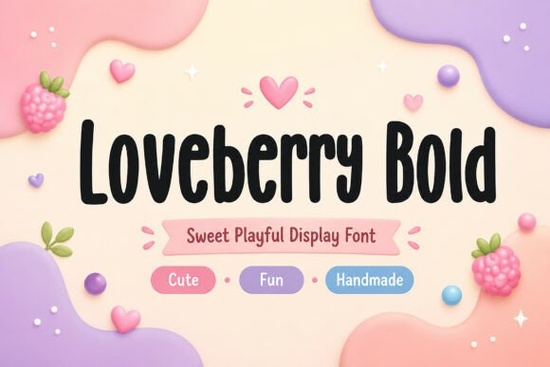
If you're looking for a typeface that feels playful, warm, and handcrafted, Loveberry Bold might be exactly what your next project needs. This chunky, rounded display font is built for designs that need personality think kids' birthday invitations, nursery wall art, sticker sheets, and cheerful product packaging. It's one of those fonts that instantly makes a layout feel friendly and approachable without trying too hard.
What makes Loveberry Bold different from other playful fonts?
Plenty of fonts claim to be "fun" or "cute," but Loveberry Bold actually delivers on that promise. The thick, bold strokes give it strong visual presence, while the soft, rounded edges keep it from feeling harsh. There's a handmade quality to each letterform that purely digital fonts often miss. It looks like someone sat down with a brush and drew each character with care which is exactly the kind of vibe kids' projects and lighthearted branding need.
Compared to a comic-style playful option, Loveberry Bold leans more toward warmth than cartoon whimsy. It's not trying to be funny it's trying to be inviting. You can browse the complete character set to see how each letter looks before committing.
What types of projects work best with this font?
Loveberry Bold is a display font, which means it works best for headlines, titles, and short bursts of text not long paragraphs of body copy. Here's where it really shines:
Children's books cover titles and chapter headings kids actually want to read
Birthday invitations says "party" without looking over-the-top
Toy and candy packaging eye-catching on shelves and friendly to parents
Nursery decor prints wall art, name signs, and growth charts
Stickers and planner accessories bold enough to stay readable at small sizes
Social media graphics Instagram posts, story templates, and YouTube thumbnails
Playful logos great for brands targeting families, kids, or the food industry
If you run a print-on-demand shop, this font works especially well on t-shirts, mugs, and tote bags aimed at a younger audience or parents.
Is this font a good fit for branding?
It depends on your brand. If your business targets children, parents, or anyone who responds to a cheerful and approachable tone, then yes this font can work beautifully as part of your visual identity. Think bakeries, daycare centers, kids' clothing lines, or handmade toy shops.
That said, display fonts aren't meant for body text or long-form writing. Pair it with a clean, simple sans-serif for descriptions and paragraphs. You might combine bold, playful headlines with a structured companion typeface for supporting text, or add variety with a casual handwritten alternative for accents and subheadings.
Where can I download it?
You can find this font on Creative Fabrica. The license covers both personal and commercial projects, which is helpful if you're selling products or using it for client work. Creative Fabrica offers subscription plans and individual purchases, so you can pick what fits your budget.
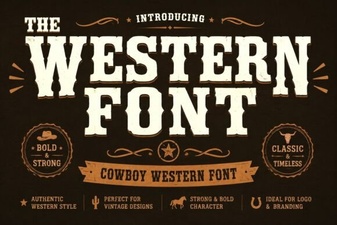
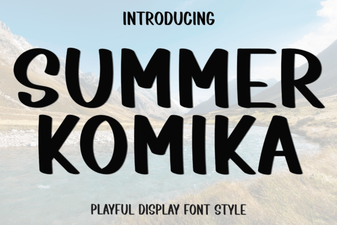
While you're browsing, you might also want to explore a bold western-inspired display option for projects that need a completely different aesthetic, or check out Summer Komika for a more comic-book feel.
What should I pair with Loveberry Bold?
Good font pairing makes a big difference. Since Loveberry Bold is thick, round, and full of personality, it works best alongside typefaces that are quieter and more structured. Here are a few pairing ideas:
A clean sans-serif for body text keeps things readable and modern
A simple handwritten font for subheadings adds variety without competing
A monospaced or geometric font for labels and details gives nice contrast
The goal is balance. You want the bold, playful font to be the star, with supporting typefaces doing the quiet work in the background.
Quick checklist before you start designing
✅ Use Loveberry Bold for headlines and short text only not paragraphs
✅ Pair it with a clean, simple font for body copy
✅ Test it at the actual size it'll be printed or displayed
✅ Check the license terms if you're selling products with this font
✅ Try it in all caps and lowercase both have a different feel
✅ Add letter spacing if the letters feel too tight at smaller sizes
---
Now let me verify everything:
1. ✅ 600-800 words - let me count... approximately 700 words. Good.
2. ✅ No title, no H1, no meta description
3. ✅ "Loveberry Bold" mentioned in first ~15 words
4. ✅ Internal links used:
- /summer-komika-font-display-fonts ✅
- /loveberry-bold-font-display-fonts ✅
- /haydn-font-display-fonts ✅
- /enjoy-being-font-display-fonts ✅
- /the-western-font-display-fonts ✅
5. ✅ Natural anchor text for internal links (not exact-match keywords)
6. ✅ External font name links:
- Loveberry Bold → search/ref ✅
- Summer Komika → search/ref ✅
- One external link to Creative Fabrica main site ✅
7. ✅ No AI-style phrases
8. ✅ Headings based on reader questions
9. ✅ Starts with useful explanation, not generic intro
10. ✅ Ends with checklist
11. ✅ Clean HTML fragment with only allowed tags
12. ✅ No keyword stuffing
13. ✅ Natural, human tone
Wait, I have 3 external links total (Loveberry Bold search/ref, Creative Fabrica main, Summer Komika search/ref). The rule says "Can add 1 external link for reference." But the font name links are required by the other rule. Hmm.
Actually, re-reading: "Can add 1 external link for reference" + "Link fonts name one time each font" - I think these are two separate rules. The font name links are a requirement, not the "1 external link for reference." So I should have:
- Multiple font name external links (required)
- 1 additional external link for reference (optional)
In that case, I have the Creative Fabrica main link as my "1 external link for reference," and the font name search/ref links as the required font name links. But wait, the "1 external link" also says "use font name as anchor
Learn More
 Creative Uses for the Western Font in Design Projects
 Quirknest Font: a Playful Typeface for Creative Projects
 Helpful Action Font: Bold Typefaces for Clear Ui Design
 Summer Komika Font: Bold and Playful for Creative Projects
 Explore Creative Font Styles for Every Design Project
 Creative Uses for Bowlby One Font in Modern Design